Showing posts with label Mina Wali. Show all posts

Saturday, October 20, 2012

Drawing 4 Peace

Please take a moment to look at these drawings! This morning I received a package from Afghanistan from our school. This should make you smile. I received a ton of drawings from our students in kindergarden to 2nd graders. They drew pictures for my mother and I. So made my weekend! Look at the colors, they are full of love & innocence. Most of the pics, they are thanking my mom for teaching them about nutrition & giving them education. :) ♥
Dina Azim, Director of HOM and Mina Wali's daughter, 12/10/2012 


Photos: HOM

Saturday, August 25, 2012

Contacts in Kabul

On November 2011, Mina Wali, the founder of Hope of Mother, went to Afghanistan for a few months. The main reason for this return was the need to develop local contacts in order to develop a draft concerning the establishment of a Vocational Center in Kabul.

This Vocational Center aims to match some of the major challenges facing Afghanistan after the withdrawal of foreign troops. Namely:

- To promote education and training;
- To create employment;
- To support entrepreneurship of Afghan women;
- To root the youth in the country;
- To aware about the dangers of drug use;

On her agenda, Mina planned meetings in several Afghan ministries, as well as in embassies and international institutions with offices opened in the Afghan capital. In Kabul, Mina had the support of Lieutenant Colonel Octávio Vieira.


Photos by Octávio Vieira

"A dream in a land of nightmares"


"In eastern part of AfghanistanShawl Pacha School seemed to be a project doomed from birth." But it did not happened. Not only the school has suceeded, but also turned into a model in this poor country. This story is told in "AMI Notícias" bulletin, of the third quarter of 2011. The article discusses the project managed by Hope of Mother and also education in Afghanistan in general.


Entitled "Afghanistan: where going to school is a dream", the article describes a visit to Mina Wali's school and explains how this project is like an "oasis" in a country (yet) so harsh to education (especially of women). "In many parts of Afghanistan, going to school is not a right, but an aspiration", one can read.

Article:
Afeganistão: onde ir à escola é um sonho, AMI Blog

Afeganistão: onde ir à escola é um sonho, AMI Notícias, 3rd quarter 2011 (distributed free with "Visão" magazine, November 17th, 2011) (appendix)


Appendix:


Wednesday, August 1, 2012

"Mina Wali, a heroic Afghan woman in war-torn Tora Bora"

During a visit to Europe, invited by the European Foundation for Democracy, Mina Wali is interviewed by "Today's Zaman", an English language Turkish newspaper. Here is the integral article.


Mina Wali is one of many heroic women in Afghanistan, which is one of the poorest countries in the world and has extremely abject living conditions. After spending 28 years in California, one of the most beautiful and wealthiest states in the US, Wali decided to return to her homeland of Afghanistan in 2003 because she felt needed to do something for her country.

Wali did something even braver -- she headed to the slopes of the Tora Bora Mountains, the most dangerous part of the country where Osama bin Laden had settled and administered his global operations for many years. Her primary reason was to make a humble contribution to her homeland by opening a school after her 28 years of comfort in California. Wali, during a visit to Brussels as an invited guest of the European Foundation for Democracy, shared the story of her return to Tora Bora.

According to the UN Human Development Index (HDI), Afghanistan ranks 155th among 169 countries; average life expectancy is 44.6 years and average education is 3.3 years. In other words, the average Afghan citizen is not even a primary school graduate. Wali, who launched a school by the Hope of Mother organization in the foothills of the Tora Bora Mountains in 2005, is trying to offer world-standard education to 500 students. What is significant about this school is that the number of girls is greater than boys. Stressing that the literacy rate among Afghan women is only between 5-8 percent, Wali notes that there are 260 girls studying at her school.


The location of the school bears symbolic significance in some respects; the name of the city where the school was opened in 2006 is Torghar, which means Black Mountain and is located on the slopes of the Tora Bora Mountains. When asked, “Why this city,” Wali responds: “When I got married, they gave me some land as dowry. When I went back to Afghanistan, I wanted to see this land. I noticed that the land was located at the base of the Tora Bora Mountains. We built the school on that land. This way, we saved money and besides, we built a school in a region that was badly in need of education.”

The first rocket against the Red Army during the Soviet occupation in the 1980s was fired in this region. Wali says that what this region needs is education and books rather than weapons.

"I have great expectations from Turkey"

Stressing how much the Afghan people love and respect Turkey, Wali is now asking for help from the Turkish people in her fight against illiteracy. She is urging the Turkish government to sponsor initiatives to open more schools in the region so that children can be saved from the streets.
Noting the success of Turkish schools in Afghanistan, Wali complains about conditions in her region and asks Turkey to consider this matter.


Saying that they are experiencing serious financial problems, Wali explains, using an interesting analogy, how she secures support for resources for her school: “When I go back to America, I am like a beggar. I ask for money from everybody I encounter. I urge my relatives and my close friends to direct their alms to the school.”

One of the reasons for her return to the homeland she left at age 17 was to find out the fate of her father, Shivali Han, one of the first pilots in Afghanistan to serve as an aide of Afghan King Zaheer Shah. Her father disappeared in the 1970s while under arrest at Bagram Air Base, which is currently being used by the Americans. Whether her father is dead or alive is still a mystery. If he is dead, his grave has not yet been identified. Wali says: “I worked hard to find out my father’s fate when I got back in 2003. We do not know if he is alive or not. We do not know the location of his grave if he is dead. I realized something during the search for my father. There are thousands of families like us; and their agony is greater than ours. Sadly, I gave up on searching for my father.”

"Osama bin Laden brought nothing but disaster to Afghanistan" 

Wali, who is in Brussels to participate in an event sponsored by the European Foundation for Democracy after Osama bin Laden was killed in an American operation, says the al-Qaeda leader exploited her people for many years. Noting that bin Laden inflicted the greatest harm on the Afghan people and Afghanistan, Wali said: “Who loves and respects these people? According to the Quran, only Allah can take away life, nobody else. Afghanistan had been in a state of war for years already; it already had many issues to resolve. Then bin Laden came and exploited the Afghan people.” Wali argues that al-Qaeda kidnapped and brainwashed thousands of orphans in Afghanistan. However, her remarks about the Taliban are more lenient. Noting that no incident of corruption was identified or discovered during the Taliban era, Wali believes that corruption cases are on the rise under the Karzai administration in Afghanistan. Wali says: “I have no problem with the Taliban. I respect Islam. The Taliban has done nothing to me or my school so far. I did not pay a dime in bribes to open the school. I should note that there is no government authority in the school district.”
 
She has no problem with the Taliban, but there have been a few attempts to kill her. She has no idea of who ordered this, but she simply says: “I could be killed at any time. What can you do if this is your destiny?”


Photos HOM


Original article:
"Mina Wali, the heroic Afghan woman in war-torn Tora Bora", Today's Zaman, 19.06.2011

Thursday, July 26, 2012

"At Tora Bora, ‘beautiful flowers will bloom'"

Mina Wali's interview during her european tour, in May 2011, invited by the European Foundation for Democracy. She participated in several conferences, organized in order to bring the Afghan civil society and the European public closer. (Integral article)


Instead of suicide bombers, it is possible to groom "nurses, teachers, beautiful housewives and good husbands" at Tora Bora, one of the "scariest" areas of Afghanistan and where Osama Bin Laden was long thought to be hiding, Mina Wali, founder of a private school in the disadvantaged area, told EurActiv in an interview.
Mina Wali has lived in the US for 28 years and returned to Afghanistan in 2005 to contribute to the reconstruction effort underway in her home country. In 2006, she opened the first 'Hope of Mother' school, which has 400 students.

She was speaking to EurActiv's Senior Editor Georgi Gotev.

You were only 17 when you left your country, Afghanistan, which was then occupied by the Soviet army. You have spent 28 years in the USA, but one day, in 2003, you left sunny California and came back to Afghanistan. Why did you do that and what happened?

First of all I would like to thank you for the opportunity that people could hear my voice. I would also like to thank the European Foundation for Democracy for inviting me to Brussels.

As to why I left sunny California and why I came back to Afghanistan, I'm very proud to say that I am an Afghan American. I lived 17 years, the best of my time, in Afghanistan, until my father was taken up. He was an air force general at the Bagram base and vanished. We don't know if he is alive or not. Other members of my family have also been captured. And then, we had no other choice but to leave the country.

My family settled in California, which has similar weather to Afghanistan. For many years, I never dreamed of coming back to Afghanistan one day. But with the help of the international community, there was a hope that we could come back. And in 2003 I visited my country, to see how it looks.

It was my curiosity, my love, my passion, everything was in Afghanistan, and especially my lost father. I always was in search of him. So I came to search for my father, because the pain I had was unbearable.

When I came in 2003, I realised it was not just me, so many other people had the same pain, even worse than me. There were people who had lost all members of their family. Then I decided: we have to be a team, we need to give each other support. When I went back to America, I decided to come back. My background is teaching, so I decided that there were enough teachers in America, but I could bring some changes in Afghanistan.


You run a school in Tora Bora, a region famous for the caves where American forces were trying to locate Osama Bin Laden. We are speaking one day after his demise. The fact that he is not there any more: what does it mean for the people of Afghanistan? By the way, what is Tora Bora, it's not only caves: there must be hope in Tora Bora as well, since you run a school there?

That's why the school is there, to bring hope to people. Thanks to the school the people start moving in that area. My school is close to Tora Bora, which we call Torghar, that means Black Mountain. At the bottom of the black mountain is my school, and except the mountain and the farming, there is nothing else. And the first rocket against the Soviet Union was fired from the area where I built my school.

And that's why I built the school, so we won’t need weapons any more. We need pens, we need to start our revolution with education. People are very traditional in that area, but they accepted me very well. It's different from Kabul, which gets a lot of attention. But I decided I should touch the untouched area. That was my goal, and that's the reason I went to a rural area. And my plans for the future are in the same way – I don't like to work in big cities where everyone is focusing. So I put my life in this line.

How much do you change people's lives? How much has your school influenced the life in the community? Do you teach school material only, or do you also teach pupils to be citizens and to be skilful in their households?

We do both. We reach them to be good at school, but also to be mannered, about social life, we also work with the families.

I personally go to the family hold and I talk to them, see what their problems are. We create jobs for them, for women who are not allowed to go out of their home. And this is not because their husband is very bad, it's because of their culture.

People believe that if a woman gets out of her home, the man is not good enough to care for the family. This is a Pashtun area. So I take stuff for them in their home to do it, and buy it back from them and sell it. It's because I want to work on the sustainability of the programme. We cannot be always dependent on the donor's help.


How many such schools are needed in Afghanistan? Maybe thousands?

More than thousands. I don't want to brag about myself, but I can say that my team is working very hard to make people become somebody. So that from that area, which always had a scary name, beautiful flowers will be blooming.

Not producing terrorists?

No, not producing suicide bombers. I want to produce nurses, teachers, beautiful housewives, good husbands, and to see them with a smile and cheery life.

Can the EU help in this effort?

Even right now they do it, but they could do more and we would love to have their support. Portugal is a member of the European Union, and even though it's a relatively poor country, it offers help trough AMI [AMI - Assistência Médica Internacional; International Medical Assistance], and I'm grateful to its president Fernando Nobre and his wife, who supported me and trusted me. We are a very good team and we work very well together.


Is this your first visit to Brussels, and do you plan to come back and build on the contacts you establish today?

I love Brussels, I love the people, and I hope they love me too. I would love to come back.

Will the demise of Osama Bin Laden change things in Afghanistan and maybe in the region?

I think this is good news for everyone. I don't know how much will change, because I'm not a politician. But definitely, there will be a lot of changes, because Bin Laden has been as a hero for those people, but now the hero is gone.

Photos HOM


Original article
"At Tora Bora, 'beautiful flowers will bloon'", EurActiv, 04/05/2011

Excerpt of the interview (video):  


Wednesday, July 25, 2012

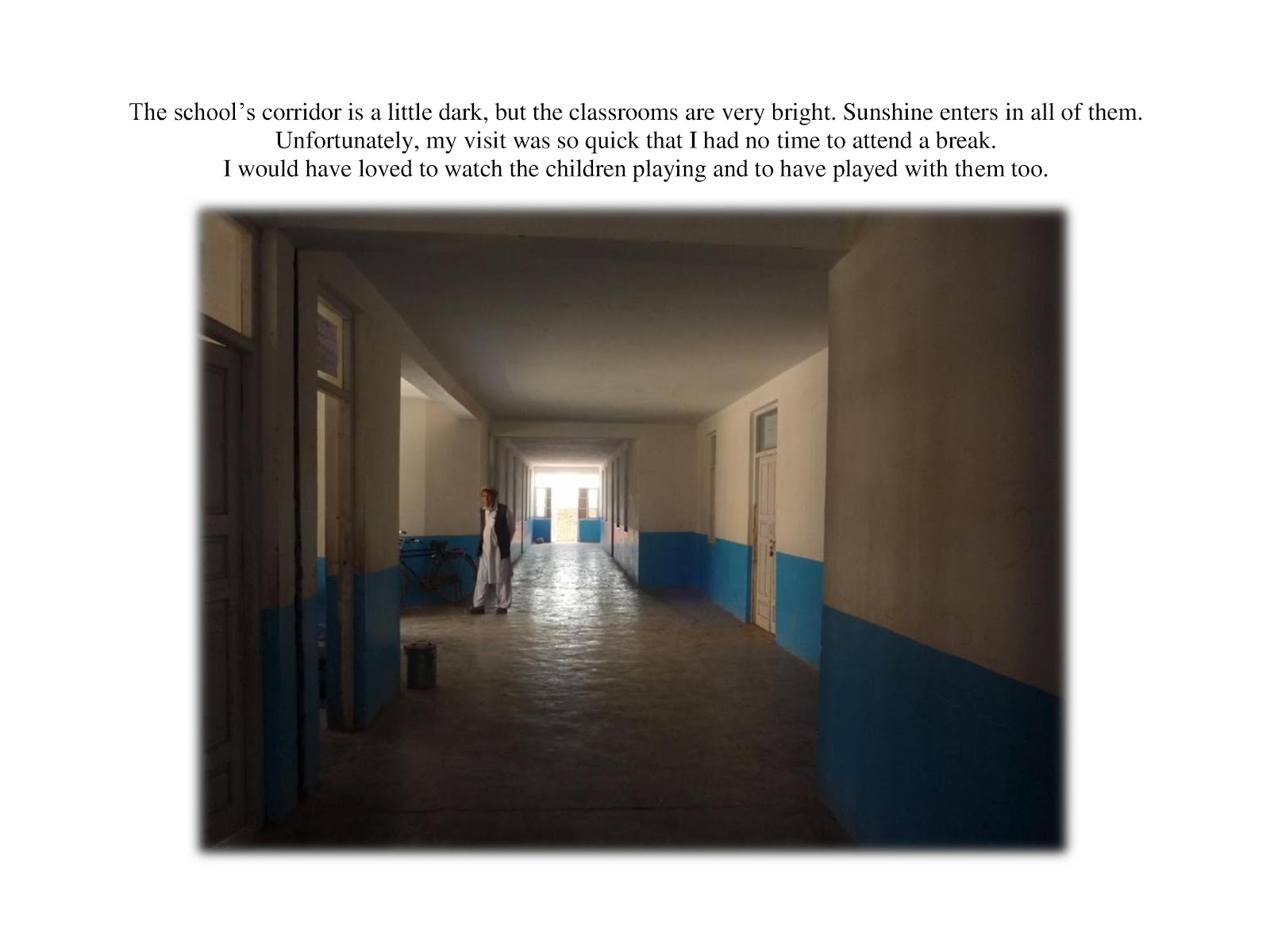
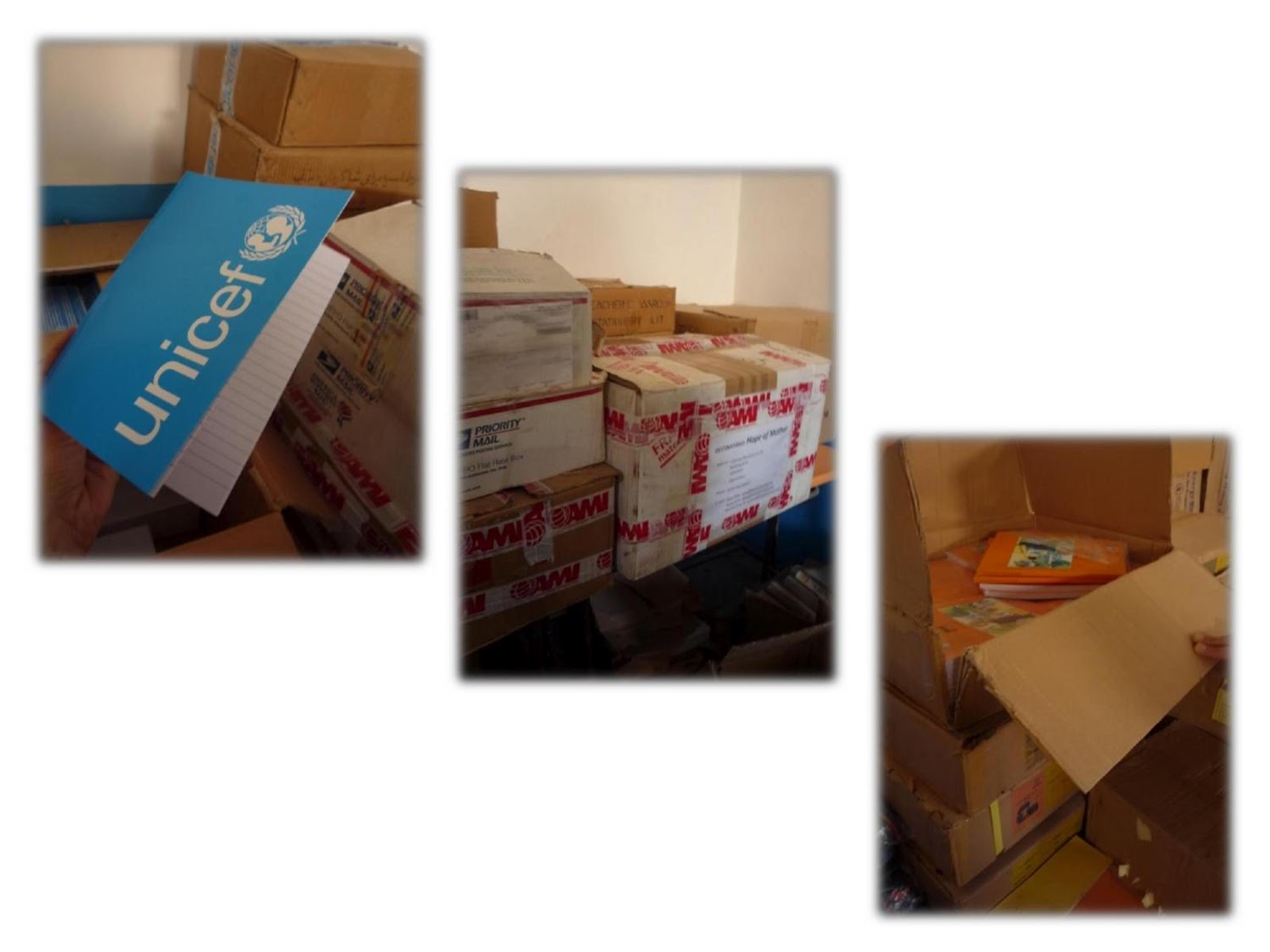
My visit to AMI's "little school"

In April 2011, I traveled to Afghanistan on work for "Expresso". Happily, I had the opportunity to visit the "little school of AMI", as I called it, in Nangarhar.

Back home, I prepared a powerpoint, which records, in an informal style, my personal impressions on this unforgettable trip.


Photos by Margarida Mota