Showing posts with label Octávio Vieira. Show all posts

Saturday, August 25, 2012

Contacts in Kabul

On November 2011, Mina Wali, the founder of Hope of Mother, went to Afghanistan for a few months. The main reason for this return was the need to develop local contacts in order to develop a draft concerning the establishment of a Vocational Center in Kabul.

This Vocational Center aims to match some of the major challenges facing Afghanistan after the withdrawal of foreign troops. Namely:

- To promote education and training;
- To create employment;
- To support entrepreneurship of Afghan women;
- To root the youth in the country;
- To aware about the dangers of drug use;

On her agenda, Mina planned meetings in several Afghan ministries, as well as in embassies and international institutions with offices opened in the Afghan capital. In Kabul, Mina had the support of Lieutenant Colonel Octávio Vieira.


Photos by Octávio Vieira

Thursday, August 9, 2012

Hope of Mother call


Kabul, Afghanistan

October 2011


The winds of time are passing by all over the world, and we are facing and living crucial historical moments that might challenge our own survival as human beings. Things and changes that we thought would never happen are taking place everywhere. Afghanistan is one of the countries where we can feel those winds of change. In fact, NATO and other International Organizations will start leaving the country soon, along with the transference of security and governance to afghan hands.

Thousands of jobs might be in risk due to that, and the majority of the Afghans don't have any special skills or learned any specific profession. In the last 10 years, millions and millions of euros were invested on education - schools and universities - but still the new graduated students don't have a place to go, after their graduation. The only way to get a job is to fly abroad, leaving the country without their best skilled men and women.


The afghan non governmental organization (NGO) Hope Of Mother (HOM), in partnership with the portuguese Foundation AMI (Assistência Médica Internacional) have been developing an outstanding humanitarian work provinding, since 2006, education and health care to more than 600 boys and girls in a school in Nangarhar, Jalalabad province.

AMI funded and continues funding the project, and the school is actually considered a model school to all Afghanistan. But there's still a lot to be done, if we want a prosper afghan economy with the help of their youth, men and women. HOM, sponsored by AMI, is developing a project that can be seen as the best solution for the incoming problems, which is the constrution of a Vocational Center in Kabul, that will be able to train and teach all the ones who want to learn a profession, a job.

Those job learning courses will be paid, like the ones that take place in Europe, but a solid and well structured project must be developed in order to be presented to the European Union or other institutions as a Funding Candidate.

The project is already being built by HOM, in the US, with some added ideas like the inclusion of a Graduate Work Placement for new graduated students looking for their first job. This intents to absorve the graduated students from the universities, give them a job and keep the best skilled elements inside the country, ensuring the future of Afghanistan.


Please help us, spreading the Hope of Mother page in Facebook and giving/sending us YOUR IDEAS/PROPOSALS that might improve the project, turning it as one FROM ALL OF US, but most of all, a Project for the Future of Afghanistan. 
 
Thanks indeed.
Octávio Vieira
 
Photos HOM


Tuesday, July 17, 2012

"Going to school to counter the destiny"

I first heard about Shawl Pacha School and AMI's participation in the project on 23rd June, 2010, during a seminar in Lisbon, at the Institute of National Defence (IDN), entitled "Afghanistan: What future?".

Lieutenant Colonel Octávio Vieira took part in that seminar. He was the one who established the first contact between Mina Wali and Dr. Fernando Nobre. In the panel "Afghanistan: The need for integrated responses", he developed the "humanitarian effort" idea, giving as an example of what can (and should) be done in Afghanistan "the school funded by AMI, considered a model by the Afghan Ministry of Education".

I realized the extent of his words and decided to write an article for "Expresso" newspaper, where I work. By phone, I interviewed Mina Wali, Octávio Vieira and Tânia Barbosa, the latest a member of the International Department of AMI. On 30th December, 2010, it was published the article "Going to school to counter the destiny", in the printed edition of "Expresso".

At the same time, I prepared a dossier for "Expresso Online", where it can be found the texts published in the printed edition, an excerpt of Mina Wali's interview (audio format) and a photogallery provided by AMI.

From this article, and due to the empathy with the people I interviewed, I fell in love with this project and started dreaming about a visit to its location...


Margarida Mota

Articles:
"Going to school in Afghanistan," Express Online, 05/01/2011

"Going to school to counter the destination", Expresso, 12.30.2010 (Appendix)


Wednesday, April 11, 2012

Shawl Pacha school opening

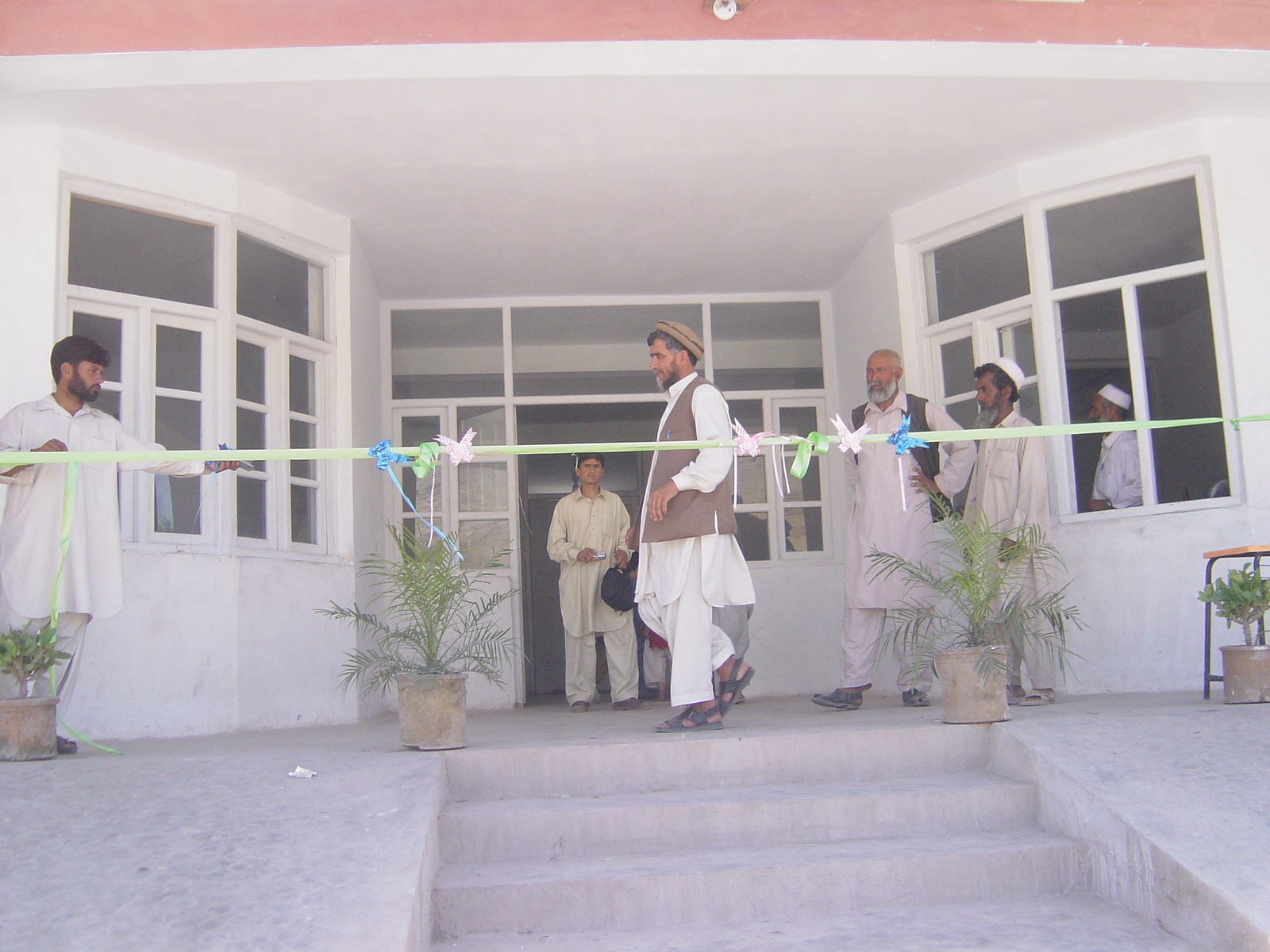
April 28th, 2008, Surkh Rod, Nangarhar province: Shawl Pacha school opening

School entrance
Playground in front of the school

A HOM and AMI partnership

Preparations for a feast day on the ground in front of the school
"The people of Surkh Rod village have become so dependent on the outcome, security, safety and shared resources of the Shawl Pacha school, that they see it as the key to peace and stability. Years ago, when we initiated the concept, the people and children did not know, feel or see the significance of an educational institute. They did not believe in the social impact it would have on the village and on the entire province and neighboring provinces." (Mina Wali)
Many villagers attend the ceremony


Fernando Nobre speaking to the people
Mina Wali making her speech in such an emotional day to her
The representatives of the female students
A message from the students
"The youth in our institution, for the first time, demanded that women were responsible for cleaning the school, and that no man was present. Now, everything is reversed. They realized that education has no borders and require people - no matter men or women - to teach and guide them." (Mina Wali)
Walking to the entrance of the school
School's entrance
Mina Wali and Ahmad Shaw cutting the ribbon

In the middle, Ahmad Shaw (HOM) and José Luís Nobre (AMI)

Media's coverage in a historic day for the region
Octávio Vieira and Tareq Azim, in the hallway, surrounded by students

In April 2008, tribal leaders from Kunar province (neighboring Nangarhar) visited Shawl Pacha school to be aware of the project: How does it work? Who runs it? What entails building a successful institution for future generations?

The importance of this visit was huge, because Kunar is one of the afghan regions where taliban's influence is stronger, thus less susceptible to some kinds of projects, particularly in education area. After the visit, HOM was assured that Shawl Pacha school is welcomed, in Kunar province, and supported by all political and social sectors.


Girls and boys attend classes separately

In 2010, the number of girls surpassed the number of boys, at school


Photos by Octávio Vieira

Friday, March 30, 2012

Octávio Vieira, soldier and dreamer

In his own words, Lieutenant Colonel Octávio Vieira reports how he met Mina Wali and how the Portuguese NGO Assistência Médica Internacional (AMI) embraced Hope of Mother’s project (HOM) from the outset.

A happy meeting
In September 2005, while I was a PSYOPS (psychological operations) officer in ISAF’s (NATO military coalition in Afghanistan) headquarter in Kabul, I met Mina Wali Azim. She was running a company that distributed informative products developed by NATO’s PSYOPS cell.
She was a member of a well known pashtun Afghan family. Her father was an Air Force commander and an aide of Afghan King Zahir Shah. By the time of the Soviet invasion, in 1979, she was forced to flee to the U.S., where she was given American citizenship. There she rebuilt her life.

In 2003, after September 11 and the following U.S. and NATO military operation in her country, she decided to return to Afghanistan to look for her father’s body and to build something on the land she owned in Jalalabad, Kunar and Pakthia areas, near the border with Pakistan.

The several conflicts suffered by Afghanistan in previous years had caused many casualties among the population and a high number of orphans, abandoned and homeless people, beggars... Beyond this tragedy, she returned to the U.S. willing to create an NGO. That’s how Hope of Mother (HOM) was born, aiming to support children building schools and clinics.
There is ground, money is missing
Mina was determined to build her project, so she quitted her job in San Francisco and returned to Afghanistan in 2005, as the manager of a company that distributed informative products, which allowed her to celebrate a contract with NATO.

The day I met her, after a working meeting, she presented me her project and showed me a brochure previously prepared and printed in San Francisco. She asked me if I could help her, forwarding it to any entity or officer of ISAF’s humanitarian area. She sought financing to build schools. She had, already, an architectural project.
For me, Mina Wali’s proposal was a happy coincidence, giving me the chance to grab all the available documentation and to develop contacts at all levels, inside and outside ISAF headquarter. If everything failed in Kabul, I was determined to try in Portugal.
AMI says 'yes' to the project
After presenting the project to several NATO countries, none of them showed interest. So, on my return to Portugal, I started contacts with several entities connected to humanitarian assistance. I also contacted newspapers and televisions.

Two days after sending an email to Assistência Médica Internacional (AMI), I received a call from the secretary of the AMI’s President to settle a meeting. On January 9th, 2006, I met with Dr. Fernando Nobre and his wife, Luisa Nemésio, and presented them with all the documents, brochures, school and clinic plants, Hope of Mother’s certificate, its registration in San Francisco and the authorization by the Afghan government to operate in the country.
At that meeting, it was decided that the President of AMI would go to Kabul, between February 14th and 20th, 2006. I had a month to organize the whole trip, together with Mina. Back in Kabul, I drew up a program and sent it to AMI. It included meetings with representatives of the European Union and the Afghan Ministries of Education and Health, as well as a visit to Mina’s lands where the project would be built and, very important, meetings with local leaders, something that, according to Mina, was crucial for the success of the project.
During January and February, Mina made several contacts and had meetings with these leaders to gather opinions, advice, and get their agreement to build the school. On February 14th, 2006, the visit of the President of AMI to Afghanistan started.
Fernando Nobre in Kabul

Fernando Nobre, Mina Wali, Octávio Vieira
In front of the King’s Palace, severely damaged
Kabul in the back
The President of AMI, together with the President of HOM, held meetings with local leaders and representatives of the Provincial Reconstruction Teams (PRT) working in Nangarhar. After meetings with the Ministers of Education and Health, AMI guaranteed the support to Hope of Mother.
Presidents of AMI and HOM meet the afghan minister of Education and his deputy ministers
Meeting with an European Union representative
School ready on time
AMI has agreed on a financial support of $100,000 for three years, renewable for two extra years, aiming the construction and maintenance of a school and a clinic, in Jalalabad area. The work began in July 2006. The first classes were held in September 2007.
Initially, there were in the school 440 students, from various ethnic groups – pashtuns, uzbeks and many kuchies (gypsies). The school employed 16 teachers (eight men and eight women), three officials for school maintenance, a responsible for the religious duties and a nurse.
After returning from a mission in Iraq (2007-2008), in February 2008, and after further discussions with AMI’s President, we agreed to return to Afghanistan in April 2008 in order to participate in the “official” opening of the school (already built) and of the clinic (under construction).
The ceremony was attended by several members of the government, local PRT’s representatives, religious authorities and media professionals.
Cut the ribbon
Next to the female students
Next to the male students
Wearing a turban given to him as a sign of honor and respect.  
According to the Afghan tradition, the man who uses it becomes part of the community

The ideal model
After beginning to work, the school was honored with several awards by the Ministry of Education. Due to the facilities available, it was considered a model school.
The formula chosen by AMI is considered the most suitable: an afghan national (Mina Wali) helms the project, it respects local values, creates employment and provides education, following a diverse program, rated as the most appropriate regarding education in Afghanistan.
The Portuguese NGO finances, step by step, and oversees the project, which doesn't tamper or interfere with the social organization of such a sensitive region. The Unites Nations, itself, made this recognition and, in September 2008, inscribed AMI in the list of NGO in Consultative Status with the Economic and Social Council of the United Nations.
Photos by Octávio Vieira

Lieutenant Colonel Octávio Vieira profile:

Em missão humanitária, Gingko, julho/2009 (in Portuguese)


Video
Manter a paz num cenário de guerra, Companhia das Manhãs, SIC, 30/12/2010 (Portuguese television) - temporarily unavailable